Tuesday, 29 April 2014

Deep Cove: Land of the Lotus-Eaters.


Fiordland is, without a doubt, my favourite part of New Zealand. Silver sounds wind their way inland like hungry snakes, where they are fed by great curtains of water crashing down the forest-swathed mountainsides. I, and my field assistant, have just returned from Deep Cove, which had everything that I love about Fiordland but with fewer people and more wildlife.


Or at least, I think it did. I don’t really remember. Luckily, I took notes while stuff was happening, so I have a basic record of a couple of the last few days.


Diary of first day. Click to enlarge
Diary of second day. Click to enlarge

I have no record of the last day, although this photo suggests there was a lobster involved.


So, we found C. sylvatica, which was the main thing. But what caused all the tiredness? We have two theories. Firstly, the sky was always really dark and heavy with rain, and the air damp and cold. All the time we were inside, we had the heater and electric lights on. Additionally we were working in forest and huge mountains concealed most of the sky. Darkness causes us to produce melatonin, the sleepy hormone.

Secondly, Deep Cove has no internet or cellphone reception. We hardly saw any other people. We were so removed from societal demands. My field assistant has recently been under immense pressure at university, and I have just come away from a conference, so we were both rather exhausted. Deep Cove’s serenity and isolation may have just given us the right environment to relax, rest and recuperate.

I have other theories too – maybe there is experimentation going on with different kinds of sleeping gas used for war and mind control. Or maybe terrible things are happening at Deep Cove that the government wants us to forget, so they drug the water. Maybe it is a combination of all of the above. Who knows?

The whole experience reminded me of The Odyssey, when Odysseus and his crew arrive at an island where the inhabitants get high on lotus all the time. Odysseus’ crew tries the lotus, and they end up forgetting all their troubles and wandering around in a groggy haze. It distracts them from their travels, and Odysseus has to leave some of them on the island. Luckily, Deep Cove wasn’t so incapacitating that we couldn’t leave. I also managed to get some writing done (I have to correct a paper and write a letter, a newspaper article, a thesis and a six month report). Haven’t looked at it yet though so it might be a bit senseless.

Tuesday, 15 April 2014

Operation Trapdoor


There's no way around this. This post will be looooong. I won't be offended if you only read part of it - but so much has happened.

 Stewart Island - Halfmoon Bay
Unlike North and South Island, Stewart Island is full of what little native wildlife is left in New Zealand. Most of it is a reserve, covered in rainforest. There is only one small village (Oban), with roads. I've been here before, but only for a few days. This time we (my new field assistant and I) are looking for a few species of Cantuaria which are only found on Stewart Island and its offshore islands.

On Stewart Island, we went for walks in the bush every day and found spiders everywhere. There are three major species here, and hopefully we have found them all. I also hung up a poster in the community notice board, and was contacted by several people who have found spiders - excellent leads. Most people who we met had seen my poster, too. Small communities can be very useful!

Stewart Island Cantuaria
Every couple of days, we took a water taxi to an island, but the rest of the time we stayed on Stewart Island. We were constantly liasing with Rakiura Charters (water taxi company) and the Department of Conservation (DOC), who took our work very seriously and were keen on health and safety. I had to name my project for their files, so I called it Operation Trapdoor. Every time we contacted DOC to tell them we were safe, we had to say we were Operation Trapdoor. My field assistant protested, but since I am the leader, I get to choose what we are called, and she doesn't, so there.

Rakiura Charters water taxi. View from Bench Island


Stewart Island - Big Glory
Big Glory is a hunter camp a short boat ride from Oban. We camped in the bush with the kakariki, tomtits, tui, bellbirds, and kereru. The only paths were game trails, and I learnt a few things about tracking deer from my field assistant (who is a hunter).

While I finished setting up camp, my friend went to use the facilities, and happened to choose an area where there were Cantuaria burrows. Lots of burrows! We dug up a few spiders before heading out to search for more, but the only ones we could find were around our camp.

The forest was dark and wild, but beautiful. I grew up on common land, with wide open meadows interspersed with trees. I could always see the horizon. The woods are always quite an exciting place to be; you can never tell what is around the corner. There is so much diversity underfoot and all around you. Lichens, mosses, plants, birds, and invertebrates were everywhere, and Entoloma hochstetteri (mushrooms) showed up as shocking blue flashes as we walked along. I kept on thinking of the few lines written by Robert Frost:

The woods are lovely, dark, and deep, 
But I have promises to keep, 
And miles to go before I sleep, 
And miles to go before I sleep.

Big Glory bush

We went a long while without seeing much of the sky, the horizon, or anything that wasn't directly in front of us. It was a wee bit claustrophobic. That night, the slight uneasiness kept us awake, which was great because we heard wild kiwi calling to each other nearby.

Whero Rock
Whero Rock's resident, Cantuaria isolata, is aptly named - Whero is a rock in the middle of the ocean, with no shelter, no beach, and only bird crap for soil.

The popular tourist destination that is Whero Rock. The bright white spot is a small fishing boat. The large patch of white is bird crap.


Landing was tricky. There is a large population of great white sharks around this area, and they like boats because of fishing and shark cage tourism. To get from the boar onto Whero, we had to leap from a rubber dinghy onto the rocks, then climb up rocks covered in slippery seaweed, bird crap and dead bodies. I got very wet and covered in the white stuff, and my field assistant wore a plastic bag on her hands so she didn't have to touch it.

Long ago, when C. isolata was last found there, Whero Rock had a hut and a tree. Neither exist any more, and I figured C. isolata may have gone extinct due to lack of soil or shelter.

I was wrong! We found a healthy population sheltering under rocks and the remains of the hut. After being on the tiny rock for four hours, my field assistant was totally over spidering and had called Rakiura Charters to pick us up. It was a good thing too - the perfect day had changed, the wind picked up, the sky darkened. No way would we stay overnight on such an exposed rock. We were glad to return to our backpackers, and to shower and wash our clothes!

Bench Island
The final island we visited was Bench. The dangers there were not sharks and rocks, but fur seals. Everywhere were seals with pups, and we had to walk and talk loudly so that they knew where we were. The key, we were told, was not to get between them and the sea.

For a while we searched fruitlessly. We stuck to the beach: the bush was filled with muttonbird burrows, which are easy to collapse. It was hard to search there anyway and fur seals were hiding in the bush. We found some burrows, but they did not look right; there was far more silk around the entrance than usual. Finally, my friend yelled out that she had found a burrow halfway up a bank. Many more burrows surrounded it, some with lids, others with partial lids, and some completely open. We dug, dug, and dug some more until we had collected our quota of five spiders.

Spiders on Bench Island
You will notice that these are much smaller than the other pictures I have posted - the southern, unlidded (or partially lidded) spiders I have found are quite a bit smaller than their northern counterparts and lidded Cantuaria.

We have had so much success on Stewart Island that we rebooked our ferry to take us back early (also because this place is very expensive). Tomorrow morning we leave. I had better go and pack.


Photos by Ashley White

Friday, 4 April 2014

Things that go "Ahem" in the night

I'm now in Dunedin, having spidered in Oamaru, Hakataramea, Duntroon and surrounding areas. I caught more spiders than I had expected, and I really hope they're not all the same species. Most of them are pretty big and made me jump the first few times they came out of their burrows.


The tethered beetles are doing well; none have been eaten yet, although the last of my carabids was munched by an angry mummy spider (all I got back was a leg).

While catching spiders at night, I am very focused on the burrow, waiting with bated breath for the beast to rise from the bowels of the earth (or rather, <30 cm from the surface). The concentration makes me lose awareness of my surroundings, so between burrows I take a minute to look and listen for odd goings on.

A few days ago I was collecting from a population near Five Forks. The night was pitch black, windless, and silent. I was leaning against a clay bank, beetle in hand, when a terrible screaming howl startled me. "It's nothing," I told myself. "Someone has probably left their dog outside." Again and again the screaming reverberated through the air; it sounded more like someone was sawing the tail off the dog. I tried to blank my mind to it, and continued to try to get the spiders to come out. Perhaps it was my waning patience, but they seemed not to want to come out at all. The atmosphere was chilling and I felt on edge; I just wanted to get the spiders and leave. Even without the dog screaming in the distance, I could feel that something wasn't right. I'm not one to respond to my gut feelings, but the darkness had got to my senses.

The screaming stopped, and the silence flooded back in. Still there was a feeling of tension, as there is in a flock of pigeons when a goshawk is watching them from the bushes. Then I heard a cough - not loud, but near, and stifled, as if the cougher did not want me to know they were there. I bolted for the car and drove to the next spider population. It was probably my imagination, I was hearing things...but the spiders were not coming out anyway (and the population was very small), so maybe it would have been fruitless to stay there.

Monday, 24 March 2014

More Canterbury and Banks Peninsula

Tomorrow I head down south. Today was my last day around Canterbury and Banks Peninsula.

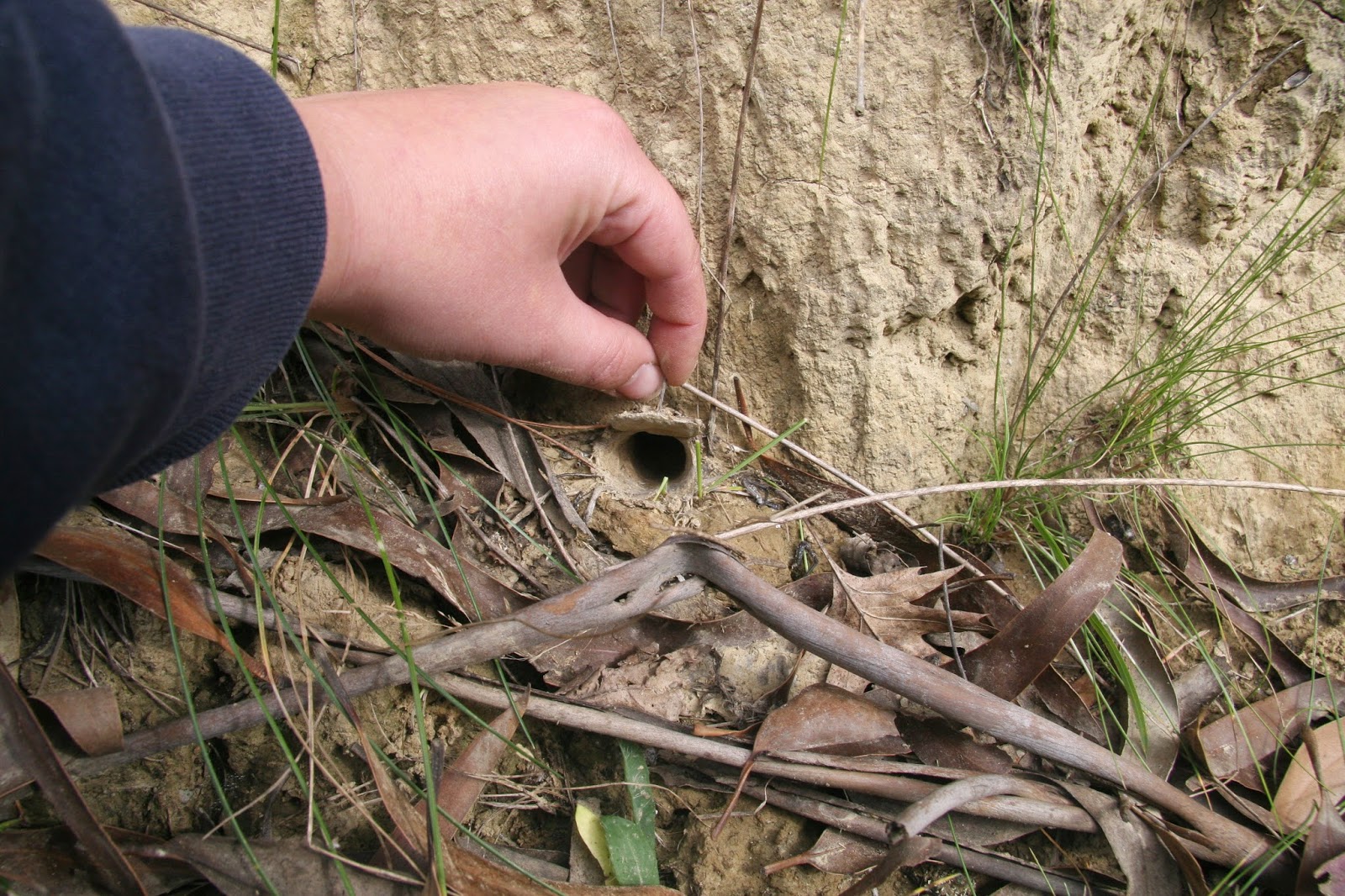
This last 10 days I have found seven populations of Cantuaria burrows. Much better success than I had expected, considering I am just warming up, but the recent rain has made the burrows much easier to find (the surrounding soil dries out much more slowly than the thin trapdoor lids, which show up pale against the dark damp background). Many of the spiders have had to fashion new lids to their burrows, the poor wee buggers. The rain has smoothed a lot of them down, which will make them harder to find when everything dries out again.

I have moved away from using the big fighty aggro carabid beetles to flush out Cantuaria. It was great for a couple of times, but most of the time when I have used them the spider has stayed down the burrow and (presumably) been munched by the carabid. I have contemplated gluing the beetles' jaws together, but these are native beetles and that isn't exactly ethical. If I can create some kind of tiny muzzle for them that can be removed, I will do that instead.

Some of the populations I have found are really small. I found a tiny one on a bush track near Oxford (the description in the Book, by Forster and Wilton (1968), says "Chalk hill in Canterbury" - thanks guys). Three large burrows. Surrounded by tiger beetle holes. I couldn't find any more burrows, and not for want of searching. I fear that population is on its last legs, possibly due to the tiger beetles eating all the young spiders. One that I found this morning only had one (again very large) burrow in it, but about 30 metres or so further up the track was another population; the two were probably once joined (and may still be connected by males, or by burrows that I didn't find).

I stay up late most nights to catch the spiders, but if I don't do any catching one night then I get up early the next morning to find more populations. Plus there have been a few things to tie up at work which have meant late nights even when I'm not catching. Late nights, early mornings. Sometimes early nights which throw me right off. I have no idea whether it's night-time or Wednesday. Hopefully I'll get into some kind of routine. My routine before was nice. Overall though, it's refreshing to only have one thing to do - find Cantuaria, and find more Cantuaria, and do not think about anything else.

Tomorrow, Kakahu. Tonight, sleep.

Tuesday, 18 March 2014

Canterbury

Today is my fourth day of collecting. The last three days have been eventful but I have still managed to end up with no spiders. I think the weather hasn't helped, as a lot of clay banks have been eroded by the recent storms.

On Sunday, I planned to go to Kennedy's Bush and Governor's Bay. Kennedy's Bush, however, was not where Google Maps said it would be (on Kennedy's Bush Road). I drove around Kennedy's Bush Road for a while, got lost, then found a clay bank that made me immediately certain that there would be Cantuaria there. I'm not sure exactly why this clay bank was such a dead cert to me, but I got out and searched and found burrows. Awesome. Unfortunately the rain was somewhat torrential and the wee buggers wouldn't come out, and digging them out just ended up with a bunch of mud being washed down the stream that I was standing in, and I got covered in it. So I marked the burrows with sticks and on the GPS, and went to Governor's Bay.

At Governor's Bay I was feeling pretty sick so I went into a cafe/information centre and sat down for a bit. I started talking to the staff about trapdoor spiders, and one guy pointed me in the direction of Ōhinetahi Valley, where he'd dug one up once. I headed in that direction and searched the clay banks around the area, but couldn't find anything. There was a wee track through the bush (which was mostly underwater), so I swam down that for a bit and climbed (and slid down) some more clay banks, mud banks, mossy banks. No burrows. I set some pitfall traps and asked the SatNav to send me home.

The SatNav had other ideas, and we went up through Gebbie's Pass (which was covered in fog so thick that I couldn't see the headlights of a car 15 metres in front of me), down a different road where I saw a sign to Kennedy's Bush, and then back to Governor's Bay. On the second try, I tried to find the place near Kennedy's Bush Road that I had found the burrows, but couldn't relocate it.

On Monday I went with a friend to Kaituna Valley and Prices Bush, where we found loads of open burrows (Cantuaria borealis?). I also caught a couple of big, mean carabid beetles to flush the spiders out. When we returned to the area after dark, I shoved a harnessed carabid down a burrow and a big female came out with all her little baby spiderlings (which was really nice to see). However, the female's spinnerets (little finger-like projections sticking out from the rear) were far too long to be Cantuaria. I figured she was probably Stanwellia instead, and let her go (even if she had been Cantuaria I would have let her go so she could look after her spiderlings). We found three more Stanwellia but no Cantuaria. I also hit a hedgehog (pest in NZ) and took it home for tea. There are some benefits to driving around a lot at night.

Yesterday I was meant to search "Port Hills", but the Port Hills cover a huge area. I ended up driving around as much of the Port Hills as I could, looking for clay banks, and then searching Victoria Park. I didn't find any Cantuaria, although tiger beetle burrows were everywhere.

Today I am going to search Springfield (and hopefully catch some spiders from the mystery location, which Google Maps tells me is on Cashmere Road). Wish me luck!

Tuesday, 11 March 2014

Autumn

There are a great many things I like about New Zealand. Chillaxed people, strange (if dwindling) native wildlife, and of course the scenery (which really is the essence of NZ). But their autumn just isn't right. Autumn and winter are my favourite seasons, and I love the changing colours, early frosts and different animals and fungi that are associated with it. Autumn in NZ is a very confused season though. Some days are like summer, others like winter. You get a lot of non-native mushrooms such as Amanita spp. (there are a few around the university now), and the only trees that are doing anything interesting are also non-native. NZ dips its toes into the swimming pool of winter before diving in at the deep end.


My seminar went well, I think. It's hard to know, because people never want to crush you after you present something, but I said everything I needed to say and didn't make any mistakes without correcting them (to my knowledge). I could have put more energy into the way I presented it, maybe I focused too much on getting the facts right. Now I just have to wait for the outcome of my assessment. Hopefully my assessor will let me do everything I want to do, and give me some good feedback. I don't think there should be much of a problem with anything.

So now I have to face my field trip...perhaps the reason why autumn seems particularly strange this year is because I know I am going away to look for the spiders. I'm looking forward to getting some meat into my project, turning some of my promises and ideas into reality, and figuring out what bits of my PhD I should focus on the most based on which populations I manage to find. But there is part of me that is freaking out a wee bit, because these things are hard to find, and if I don't find any then I will not be doing this PhD. But that is the nature of biology. You can't force organisms to give you good data, you just have to roll with whatever happens and have plenty of contingency plans.

I'm hoping I collect lots of spiders carrying mites and worms. Particularly worms. I'm really interested in these worms.

Thursday, 6 March 2014

Seminar and field trip - planning

Before I do all of this stuff I've been blogging about, getting excited about, and dedicating the last 5 months of my young life to, I have to ask the university's permission if I can do it. My proposal that I handed in a while back is the first part of that, but I also have to give a seminar on it. That's on Monday. I've practised it twice and have another practise planned tomorrow. I'll let you know how it goes. Luckily my friends are willing to listen to me practise and give me heaps of critique, as they know I will do the same for them.

As soon as my proposal is over, I will prepare for fieldwork! I'm pretty prepared already actually, more prepared than I have been for anything else ever. I even have a sleeping bag which I'm still starving myself to pay for (technically it's supposed to come out of my field budget, but since the sleeping bag I got given by a previous student is a summer sleeping bag and I will be camping in the damp in the winter, I needed to get a better one...which cost about thrice the entire field budget). Except for permits, because the people who I need to speak to about them keep going on holiday (what is this with useful people going on holiday all the time??!!), and transport to the less easily accessible places, because I need permits first before I know the dates. I can't do much about that. At some point it will all fall beautifully into place like a bird's feathers. Soon, I hope. As long as I find some Cantuaria.