After three months of writing, a few hours arguing with Microsoft Word, and a few more hours remembering why I hate printers so much, I handed in my proposal today. Now it will be assessed. Like most things I write it is way too long, but my supervisors did not seem to have a problem with that (they seemed to think my proposal is good, which is encouraging), so I'll see what happens.
Now I have to plan my field trip, which begins on the 9th March (in theory - I have to give a seminar on my proposal first, which might delay things). I will start off around Banks Peninsula, collecting in the many locations where Cantuaria have been found (mostly C. dendyi). Then I'll head south through Otago and Central Otago, take a couple of days out to go to a conference, visit Southland and Stewart Island, then up through the West Coast to Nelson and Golden Bay. A brief stint in the North Island will be followed by a return trip via Marlborough. Some species I won't be able to find, so I will put out pitfall traps to check during my second, briefer field trip in June.
Should be good!

Tuesday, 11 February 2014

Monday, 10 February 2014
Visiting a previous life
Before I discovered spiders in a big way, I thought I would be a raptor biologist. I'd done various things with hawks for a few years when I started my masters. I had contacts, and I have always liked hawks. I liked all other animals too (except the apes...they are gross and weird in all the bad ways). But I had decided from the age of 10 that I would study hawks.
At university I learned that it is okay to change your mind and not stick rigidly to the original plan if a better option comes along. We mostly learnt about seabirds, big cats, red deer, fish and whales during my undergraduate degree. I wanted to do my masters on something different, something we hadn't learned about, and applied to work on katipo spider ecology (Latrodectus katipo). During that year, and the following year when I returned to the UK, I learned that while falcons are fun to fly and keep, spiders are infinitely more interesting and give better data. Also, arachnologists in general are much better people than ornithologists in general (ornithologists tend to see you as competition, while arachnologists by comparison seem to regard their colleagues as fellow explorers of the unknown). I decided I would carry on down the arachnology route to see how far I can get. I will most likely have to hop off this train to study other taxa at some point, but I'll ride it as far as it will go.
My falcon world has dwindled into a hobby (Falco subbuteo), and sometimes I think of giving it up altogether when I clash horns with a particularly nasty example of an ornithologist. But when I have fun with falcons it is really fun. Days spent tracking a falcon who can fly faster than you can drive; the flood of adrenalin when a rabbit you are hunting explodes out of its warren; the satisfaction of getting a hawk to eat from your glove for the first time. That was going to be my life. But I have found a better one - a deeper intrigue and sense of challenge, a whole world that is virtually unexplored. People used to tell me that nobody studies the New Zealand falcon (Falco novaseelandiae). That is a lie. Plenty of people study it, and there is little left to be discovered, when you consider the number of people who study even the most charismatic of spider species.
I went this weekend to visit some falcon breeders who I have known for a few years. Stepping back into the falcon world is like crossing a vortex into a different reality. I loved visiting, and there are some great falcon-related opportunities for me, so it can continue to be my hobby. But I am glad to return to my spidery world. If I could visit my 19-year-old self again, just as she is beginning university, I would say open your mind! There are weirder and more fascinating things out there that you don't even know about yet!
At university I learned that it is okay to change your mind and not stick rigidly to the original plan if a better option comes along. We mostly learnt about seabirds, big cats, red deer, fish and whales during my undergraduate degree. I wanted to do my masters on something different, something we hadn't learned about, and applied to work on katipo spider ecology (Latrodectus katipo). During that year, and the following year when I returned to the UK, I learned that while falcons are fun to fly and keep, spiders are infinitely more interesting and give better data. Also, arachnologists in general are much better people than ornithologists in general (ornithologists tend to see you as competition, while arachnologists by comparison seem to regard their colleagues as fellow explorers of the unknown). I decided I would carry on down the arachnology route to see how far I can get. I will most likely have to hop off this train to study other taxa at some point, but I'll ride it as far as it will go.
My falcon world has dwindled into a hobby (Falco subbuteo), and sometimes I think of giving it up altogether when I clash horns with a particularly nasty example of an ornithologist. But when I have fun with falcons it is really fun. Days spent tracking a falcon who can fly faster than you can drive; the flood of adrenalin when a rabbit you are hunting explodes out of its warren; the satisfaction of getting a hawk to eat from your glove for the first time. That was going to be my life. But I have found a better one - a deeper intrigue and sense of challenge, a whole world that is virtually unexplored. People used to tell me that nobody studies the New Zealand falcon (Falco novaseelandiae). That is a lie. Plenty of people study it, and there is little left to be discovered, when you consider the number of people who study even the most charismatic of spider species.
 |
| Down the spider-hole... |
Monday, 3 February 2014
Essence of spider
I'm meeting with my supervisory team this Friday to discuss my methods, now that the proposal is almost done. While waiting for proposal corrections and stuff, I have been doing a few things that will hopefully mean I can hit the ground running when I get official permission from the university.
As I have slowly been facing the ugly truth that Cantuaria taxonomy is far from straightforward, I have been compiling pictures of the abdomens and genitalia so that I can quickly narrow any specimen down to a near match. This should speed up identifying each one that I collect. The definitive works on identifying New Zealand spiders are the "Spiders of New Zealand" books by Ray Forster and others. The second book in this series (Forster and Wilton, 1968) describes all known species of Cantuaria. I have been using it to identify the spiders I currently have in the freezer, focusing particularly on the genitalia but also claws and abdomen patterning, as the authors seem to consider those characters most useful to distinguishing species.
However, my advisor and I have discovered that claws are pretty meaningless, varying in their notch patterns between individuals, and I emailed another spider guru who told me that he usually goes by male genitalia, and if he finds a female in the same place that looks similar then they are probably the same species. Most of the characters in the literature are next to useless. So....cock.
By the way, in case you are wondering what spider genitalia looks like, feast your eyes on these beauties...


The female's internal genitalia at the top, the male's palp at the bottom. Pretty cool structures, huh?
In addition to that, designing my proposal seminar, reading stuff, applying for permits (looooong laborious process) and "collecting" more Cantuaria (more like looking for them and not finding any - good job New Zealand is scenic), I started extracting some DNA from my specimens. DNA extraction sounds cool and is full of words like "Qiagen", "elution" and "lysis" but it really is just a case of making spider soup and then washing it through a sieve to get the muck out. You dissect the muscle out of a spider leg (easy in my spiders, I pity people working on the smaller species), add some protein-cracking enzyme to it and cook it overnight. What you have in the morning is free DNA floating about with a bunch of other stuff you don't want. You then wash the spider soup through a filter using a bunch of different buffers, but you get to use the centrifuge which is cool because it always sounds like it's going to take off. Then what you have is spider DNA suspended in a solution. Essence of spider. If you can follow a recipe, use a centrifuge and a pipette, you can extract DNA. My favourite bit is the dissection but my second favourite bit is all the labelling and categorising of the samples. Organisation is important in doing molecular work so I am in my element.
I just moved house and I'm helping my friend move house, and I am also house sitting, so I have many houses at the moment and am pretty knackered. I'm going to pick one of them to sleep in and say goodnight. Goodnight!
As I have slowly been facing the ugly truth that Cantuaria taxonomy is far from straightforward, I have been compiling pictures of the abdomens and genitalia so that I can quickly narrow any specimen down to a near match. This should speed up identifying each one that I collect. The definitive works on identifying New Zealand spiders are the "Spiders of New Zealand" books by Ray Forster and others. The second book in this series (Forster and Wilton, 1968) describes all known species of Cantuaria. I have been using it to identify the spiders I currently have in the freezer, focusing particularly on the genitalia but also claws and abdomen patterning, as the authors seem to consider those characters most useful to distinguishing species.
 |
| Claws on the end of a Cantuaria leg - note that there are 3 claws, and the bigger two ("superior" claws) have a big tooth near their base. Those are the kind of characters one looks for when trying to find what species a spider is. |
However, my advisor and I have discovered that claws are pretty meaningless, varying in their notch patterns between individuals, and I emailed another spider guru who told me that he usually goes by male genitalia, and if he finds a female in the same place that looks similar then they are probably the same species. Most of the characters in the literature are next to useless. So....cock.
By the way, in case you are wondering what spider genitalia looks like, feast your eyes on these beauties...
The female's internal genitalia at the top, the male's palp at the bottom. Pretty cool structures, huh?
In addition to that, designing my proposal seminar, reading stuff, applying for permits (looooong laborious process) and "collecting" more Cantuaria (more like looking for them and not finding any - good job New Zealand is scenic), I started extracting some DNA from my specimens. DNA extraction sounds cool and is full of words like "Qiagen", "elution" and "lysis" but it really is just a case of making spider soup and then washing it through a sieve to get the muck out. You dissect the muscle out of a spider leg (easy in my spiders, I pity people working on the smaller species), add some protein-cracking enzyme to it and cook it overnight. What you have in the morning is free DNA floating about with a bunch of other stuff you don't want. You then wash the spider soup through a filter using a bunch of different buffers, but you get to use the centrifuge which is cool because it always sounds like it's going to take off. Then what you have is spider DNA suspended in a solution. Essence of spider. If you can follow a recipe, use a centrifuge and a pipette, you can extract DNA. My favourite bit is the dissection but my second favourite bit is all the labelling and categorising of the samples. Organisation is important in doing molecular work so I am in my element.
I just moved house and I'm helping my friend move house, and I am also house sitting, so I have many houses at the moment and am pretty knackered. I'm going to pick one of them to sleep in and say goodnight. Goodnight!
Monday, 20 January 2014
...you lose some
I went to Kaituna Valley a couple of days back to look for Cantuaria borealis and the ubiquitous C. dendyi. I am focussing on C. dendyi for some of my ecology studies, mainly because there are many populations around Canterbury, but also because it is the type species (the species to which the genus name is permanently linked - so if for example C. borealis was found to be more related to Australian trapdoor spiders, such that it was found to be a different genus from C. dendyi, C. dendyi would remain Cantuaria and C. borealis would be given a different genus name). Cantuaria dendyi's burrows are lidded, but C. borealis does not make lids.
The description in C. borealis just said "Kaituna valley", so I drove right into the valley and parked by the gate to a forest track. Native NZ moist forest is very exciting to me - it's full of plant species that seem so weird and exotic, such as ferns, mosses, lichens and lianas. There are also introduced species, but they hardly affect the spooky, wild forest feeling. Walking up the track, I kept an eye out for neat circles and open webby burrows. There were many tiger beetle and possibly bee burrows, and some small silk-lined burrows that I reckoned were likely to belong to tube-dwelling spiders (Segestriidae, not Idiopidae). The tubes were messy and the silk was slapped on thickly.
I found some Amanita toadstools (aka fly agaric) and stopped to look. Different stages of maturity were there, with smaller fruiting bodies pushing through the pine needles:

while the older toadstools took on a variety of different shapes:

 The white bits on the top are the remains of a thin skin (the universal veil) that encloses the fruiting body of a fungus when it is small.
One particularly brightly coloured toadstool had a wide, silk-lined burrow underneath it. Toadstool and burrow were in the middle of the path, embedded in pine needles. This burrow could be Cantuaria.

I marked the burrow and moved up further, finding a couple more burrows on the ground. They were very far apart, unlike two Cantuaria populations I had seen so far. I crawled around in the denser forest for a bit and found another burrow. Then I left to go and find some mites on Banks Peninsula, before returning after sunset (about 9pm).
It was pretty chilly and windy, but I had come prepared - weather changes quickly when you're in the middle of the Pacific Ocean. I approached the big burrow under the toadstool, which I was most sure was Cantuaria, and tickled the entrance with some grass. Soon enough, a flicker of furry feet betrayed the lady of the house. I harnessed up Pete the beetle and placed him next to the entrance. Spider feet came closer and closer, nanometre by nanometre, and I could see the claws at the tip of one of her legs in the red glow of my headlight. The beetle twitched and the spider sidled closer. She had responded so quickly to the grass, but the beetle did not seem so enticing. Pete was nearly inside her burrow now, and she made a lunge. I thrust the trowel into the ground, but she was too quick for me and had retreated underground. I had destroyed her burrow, making tempting her out impossible. I expect she wasn't hungry enough. Never mind; I know where she lives.
Frustrated, I went to look for the other burrows. The markers were nowhere to be seen. I searched everywhere, got down on all fours, used a variety of different lighting arrangements and probably walked about a kilometre up and down the hill searching. Unfortunately GPS records are not particularly reliable under forest cover. When I finally left, it was midnight. Four hours of fieldwork and no new specimens. However, it was not a complete waste of time - I learned the following things...
The description in C. borealis just said "Kaituna valley", so I drove right into the valley and parked by the gate to a forest track. Native NZ moist forest is very exciting to me - it's full of plant species that seem so weird and exotic, such as ferns, mosses, lichens and lianas. There are also introduced species, but they hardly affect the spooky, wild forest feeling. Walking up the track, I kept an eye out for neat circles and open webby burrows. There were many tiger beetle and possibly bee burrows, and some small silk-lined burrows that I reckoned were likely to belong to tube-dwelling spiders (Segestriidae, not Idiopidae). The tubes were messy and the silk was slapped on thickly.
I found some Amanita toadstools (aka fly agaric) and stopped to look. Different stages of maturity were there, with smaller fruiting bodies pushing through the pine needles:
while the older toadstools took on a variety of different shapes:
One particularly brightly coloured toadstool had a wide, silk-lined burrow underneath it. Toadstool and burrow were in the middle of the path, embedded in pine needles. This burrow could be Cantuaria.
I marked the burrow and moved up further, finding a couple more burrows on the ground. They were very far apart, unlike two Cantuaria populations I had seen so far. I crawled around in the denser forest for a bit and found another burrow. Then I left to go and find some mites on Banks Peninsula, before returning after sunset (about 9pm).
It was pretty chilly and windy, but I had come prepared - weather changes quickly when you're in the middle of the Pacific Ocean. I approached the big burrow under the toadstool, which I was most sure was Cantuaria, and tickled the entrance with some grass. Soon enough, a flicker of furry feet betrayed the lady of the house. I harnessed up Pete the beetle and placed him next to the entrance. Spider feet came closer and closer, nanometre by nanometre, and I could see the claws at the tip of one of her legs in the red glow of my headlight. The beetle twitched and the spider sidled closer. She had responded so quickly to the grass, but the beetle did not seem so enticing. Pete was nearly inside her burrow now, and she made a lunge. I thrust the trowel into the ground, but she was too quick for me and had retreated underground. I had destroyed her burrow, making tempting her out impossible. I expect she wasn't hungry enough. Never mind; I know where she lives.
Frustrated, I went to look for the other burrows. The markers were nowhere to be seen. I searched everywhere, got down on all fours, used a variety of different lighting arrangements and probably walked about a kilometre up and down the hill searching. Unfortunately GPS records are not particularly reliable under forest cover. When I finally left, it was midnight. Four hours of fieldwork and no new specimens. However, it was not a complete waste of time - I learned the following things...
- I need better markers - perhaps with reflectors.
- I need marker tape to mark the general location of burrows.
- This track will probably make a good location for pitfall trapping.
- I should get permission to be there after dark - they did close the gate and I probably shouldn't have been in there.
Saturday, 18 January 2014
You win some...
With this past week came a milestone in my career: my first peer-reviewed paper was accepted for publication. If you're not familiar with the scientific process, here's a brief description: when you have written up your research as a paper describing your study, results, conclusions and implications, you submit it to a scientific journal. The editor of the journal sends it to specialist reviewers who pull it to bits and make sure it is good science and up to the journal's standards. You get your comments back, do your corrections and re-submit it, and then the editor might contemplate sending it out for further review or they might just accept it as it is.
At least, that's pretty much what happened to me. The editor might in other cases reject the paper without review, or accept it without corrections if it's already flawless (which doesn't happen very often - scientists are very critical thinkers). The whole process takes a long time (months to, in my case, years) and is pretty tedious. But it makes sure that science is honest and true - we scrutinise each other's work and it only gets published if it's good science. At least, that is the idea, but the odd bad paper or fabricated dataset does occasionally get through, particularly if the authors are friends with the editors or reviewers, in which case there might be a bit of leniency. We are still human, after all. Knowing scientists, I think more good papers get rejected than bad papers get accepted (by good journals anyway) - science is, like many other disciplines, full of politics and personal vendettas. Some of the relationships between scientists are unbelievably complicated. Luckily I am not capable of generating such complex social systems.
Anyway, I was pretty chuffed about that, even if it was a very minor accomplishment for some work I did a long time ago. Overall this has been an exceptionally good couple of weeks, with really cool dissections (see my last post) and also a bit more funding granted to my project. I am quite scared that I am not working towards my proposal, but I'm doing other things for my project such as applying for permits, sorting out transport, and reading papers. Next week my supervisor is back, and hopefully will have some comments for me soon.
At least, that's pretty much what happened to me. The editor might in other cases reject the paper without review, or accept it without corrections if it's already flawless (which doesn't happen very often - scientists are very critical thinkers). The whole process takes a long time (months to, in my case, years) and is pretty tedious. But it makes sure that science is honest and true - we scrutinise each other's work and it only gets published if it's good science. At least, that is the idea, but the odd bad paper or fabricated dataset does occasionally get through, particularly if the authors are friends with the editors or reviewers, in which case there might be a bit of leniency. We are still human, after all. Knowing scientists, I think more good papers get rejected than bad papers get accepted (by good journals anyway) - science is, like many other disciplines, full of politics and personal vendettas. Some of the relationships between scientists are unbelievably complicated. Luckily I am not capable of generating such complex social systems.
Anyway, I was pretty chuffed about that, even if it was a very minor accomplishment for some work I did a long time ago. Overall this has been an exceptionally good couple of weeks, with really cool dissections (see my last post) and also a bit more funding granted to my project. I am quite scared that I am not working towards my proposal, but I'm doing other things for my project such as applying for permits, sorting out transport, and reading papers. Next week my supervisor is back, and hopefully will have some comments for me soon.
Tummy ache
My proposal is kind of on ice until I get the last comments back from my supervisor. While that freaks me out a bit, it has given me a chance to start getting to know Cantuaria more personally. Naturally, that requires me to dissect out their genitalia and photograph it.
Female spider genitalia is found around the top of the belly - more specifically, the anterior end of the ventral side of the abdomen. The genitalia is useful in identifying what species the spider is. I use a hypodermic needle to slice around the girly bits, then lift it off with some tweezers. At this point I am really happy that my spiders are huge, rather than tiny little things that I would end up impaling. You then put the genitalia into some clearing agent (potassium hydroxide, which is also used to make liquid soap) and incubate it at body temperature for a few hours. My advisor recommended putting it in a water-tight tube and in my pocket, but after discovering my tubes weren't water-tight and getting a very sore pocket area as a result, I found storing them inside my bra worked pretty well at keeping them warm and upright. Of course, it makes one's chest look a bit odd and lumpy. One of my friends asked me why my boob looked so odd and I told them that I had genitalia in there. They told me that is okay and they accept me for who I am. I don't get it.
Upon lifting the genitalia from the abdomen of one female, I found an odd convoluted object as opposed to the normal white meat you get underneath. I sliced down the middle of the abdomen to investigate.
 The convoluted thing seemed to fill the whole abdomen. I separated the abdomen from the cephalothorax (the front half of a spider) to have a better look, cut two flaps either side of my incision and prized them apart with tweezers.

Behold! A worm!
These nematode worms are known to infect Cantuaria from time to time. They go for the adult females and change their behaviour, forcing the ordinarily agoraphobic females to leave their burrows and seek water. Once in the water, the worm emerges from the spider and breeds. The worm eggs are laid in aquatic larvae (infective stages have been found in caddifly larvae, for example), which pupate into adults and are then eaten by a spider, and the whole cycle proceeds in all its bizarre and sadistic glory.
Next time you are marvelling at the wonder of nature, at the stunning colours of a hummingbird or the amazing engineering of spider silk, consider the spider in the photographs above. Nature is wonderful and fascinating, but dark and scary as hell. No merciful god created this.
Female spider genitalia is found around the top of the belly - more specifically, the anterior end of the ventral side of the abdomen. The genitalia is useful in identifying what species the spider is. I use a hypodermic needle to slice around the girly bits, then lift it off with some tweezers. At this point I am really happy that my spiders are huge, rather than tiny little things that I would end up impaling. You then put the genitalia into some clearing agent (potassium hydroxide, which is also used to make liquid soap) and incubate it at body temperature for a few hours. My advisor recommended putting it in a water-tight tube and in my pocket, but after discovering my tubes weren't water-tight and getting a very sore pocket area as a result, I found storing them inside my bra worked pretty well at keeping them warm and upright. Of course, it makes one's chest look a bit odd and lumpy. One of my friends asked me why my boob looked so odd and I told them that I had genitalia in there. They told me that is okay and they accept me for who I am. I don't get it.
Upon lifting the genitalia from the abdomen of one female, I found an odd convoluted object as opposed to the normal white meat you get underneath. I sliced down the middle of the abdomen to investigate.
Behold! A worm!
These nematode worms are known to infect Cantuaria from time to time. They go for the adult females and change their behaviour, forcing the ordinarily agoraphobic females to leave their burrows and seek water. Once in the water, the worm emerges from the spider and breeds. The worm eggs are laid in aquatic larvae (infective stages have been found in caddifly larvae, for example), which pupate into adults and are then eaten by a spider, and the whole cycle proceeds in all its bizarre and sadistic glory.
Next time you are marvelling at the wonder of nature, at the stunning colours of a hummingbird or the amazing engineering of spider silk, consider the spider in the photographs above. Nature is wonderful and fascinating, but dark and scary as hell. No merciful god created this.

Wednesday, 1 January 2014
Christmas spidering
I went spider hunting over Christmas. Things did not at all go to plan.
I had planned to drive from Christchurch down to Waimate, search for Cantuaria there, then go and search Oamaru. I was then going to go down to look for two species in Dunedin, drive to Clydevale and look in two locations around there, then head back and check Warrington Beach on the way.
What actually happened was some weather, and the car broke down a lot.
 I managed to look around Dunedin during a couple of hours of respite, during which I got very muddy and slid around a lot. I also learned there are many clay banks around Dunedin, and many tiger beetles, the larvae of which make small round holes in banks and seem to exclude Cantuaria.

My long-suffering friend came out to help me look. He's helped me with fieldwork before and even though he doesn't care for spiders much, he spent his day off climbing hills and clay banks and looking for things that he has never seen before. That's what I call a good field assistant.

I got to the point where I had been in Otago for nearly a week and not found a single Cantuaria. There were other cool spiders, like this Cambridgea:

If you look at his eye pattern, it looks like a smiley face! Below his eyes are the massive chelicerae, and next to those are thin arm-like appendages with bulbous structures on the end. Those are the palps, which are the male genitalia.
But I was not meant to be looking for Cambridgea. I began to think that Cantuaria were all around me but I was just not looking hard enough, or perhaps I didn't have enough skill to find them. Every time I saw a clay bank I would look so closely along it that my nose would nearly touch the clay, in case the burrows were there but I was missing them.
Then I drove to Black Bridge Road, which turned out to be a gravel road in the middle of nowhere (and of course the car decided to break down there as well). There were many clay banks there as well, but when the car broke down I searched the bank right next to it and found this:

It was the best Christmas present I could have got - confirmation that not only do Cantuaria exist away from places where there are advisors and spider enthusiasts, but that I could find them. I found around 20 more burrows, but I could have found more if I'd kept looking. Some of the holes were pretty big, others rather small.
 Some lids were neat and round, others had broken up profiles. All the burrows were smooth and round inside, and lined with silk. Many of the burrows were wider than the lids, so that there was a gap between the edge of the lid and the edge of the burrow. I wonder if those lids had been built when the soil was wet, then shrunk as they dried, or perhaps the spider had only recently moulted and only got round to adjusting the size of the burrow but not the lid.
I harnessed up the beetle, ready to work when the sun went down.


At first, no spider came out - the beetle did not seem tempting enough. Then I used my advisor's trick of tickling the entrance with a blade of grass. That was successful in getting the spider to shoot out, then quickly jump back into its burrow. Using the grass to get the spider's attention, then the beetle to tempt it fully out of the burrow, seemed to be the best method. These spiders were quite unlike the Cantuaria dendyi that we had caught last time - they were larger, blacker, and quicker. When the C. dendyi were about to attack the beetles, the lid began to open a little and you could sometimes see the spider underneath - but with these spiders (which are probably C. depressa), the lid remained closed for ages and you started to think that the spider was not going to come out. Then, just as you are thinking of moving on to another burrow, the lid flies open and a spider explodes out. The first few made me jump.
I collected four, had a look at the car, poked one of the spark plugs back in and topped up the oil. Apparently that was all that was wrong with it that time. Then I drove back, happy that I did at least manage to collect from one population of Cantuaria.
A note about Christmas and other times of traditional socialisation and celebration
I expect that, for most international students, Christmas and other celebration times can get a bit lonely. You're away from your family, most people have left university to be on holiday (but you are expected to work), and you have no money. Important things to remember are that soon the holiday season will be over and you will be no worse off for having experienced it, as self-pity soon fades when you are surrounded by exciting and difficult things to do. It is also a good idea to find people who are both nice and in the same situation as you, and spend Christmas with them. That way you kind of make your own makeshift family. I don't normally get bothered by these things though, because Christmas in NZ doesn't feel like UK Christmas at all, and because I don't much like spending my days with heaps of drunk people anyway.
Merry belated Christmas to all, and happy New Year!
I had planned to drive from Christchurch down to Waimate, search for Cantuaria there, then go and search Oamaru. I was then going to go down to look for two species in Dunedin, drive to Clydevale and look in two locations around there, then head back and check Warrington Beach on the way.
What actually happened was some weather, and the car broke down a lot.


My long-suffering friend came out to help me look. He's helped me with fieldwork before and even though he doesn't care for spiders much, he spent his day off climbing hills and clay banks and looking for things that he has never seen before. That's what I call a good field assistant.

I got to the point where I had been in Otago for nearly a week and not found a single Cantuaria. There were other cool spiders, like this Cambridgea:

But I was not meant to be looking for Cambridgea. I began to think that Cantuaria were all around me but I was just not looking hard enough, or perhaps I didn't have enough skill to find them. Every time I saw a clay bank I would look so closely along it that my nose would nearly touch the clay, in case the burrows were there but I was missing them.
Then I drove to Black Bridge Road, which turned out to be a gravel road in the middle of nowhere (and of course the car decided to break down there as well). There were many clay banks there as well, but when the car broke down I searched the bank right next to it and found this:
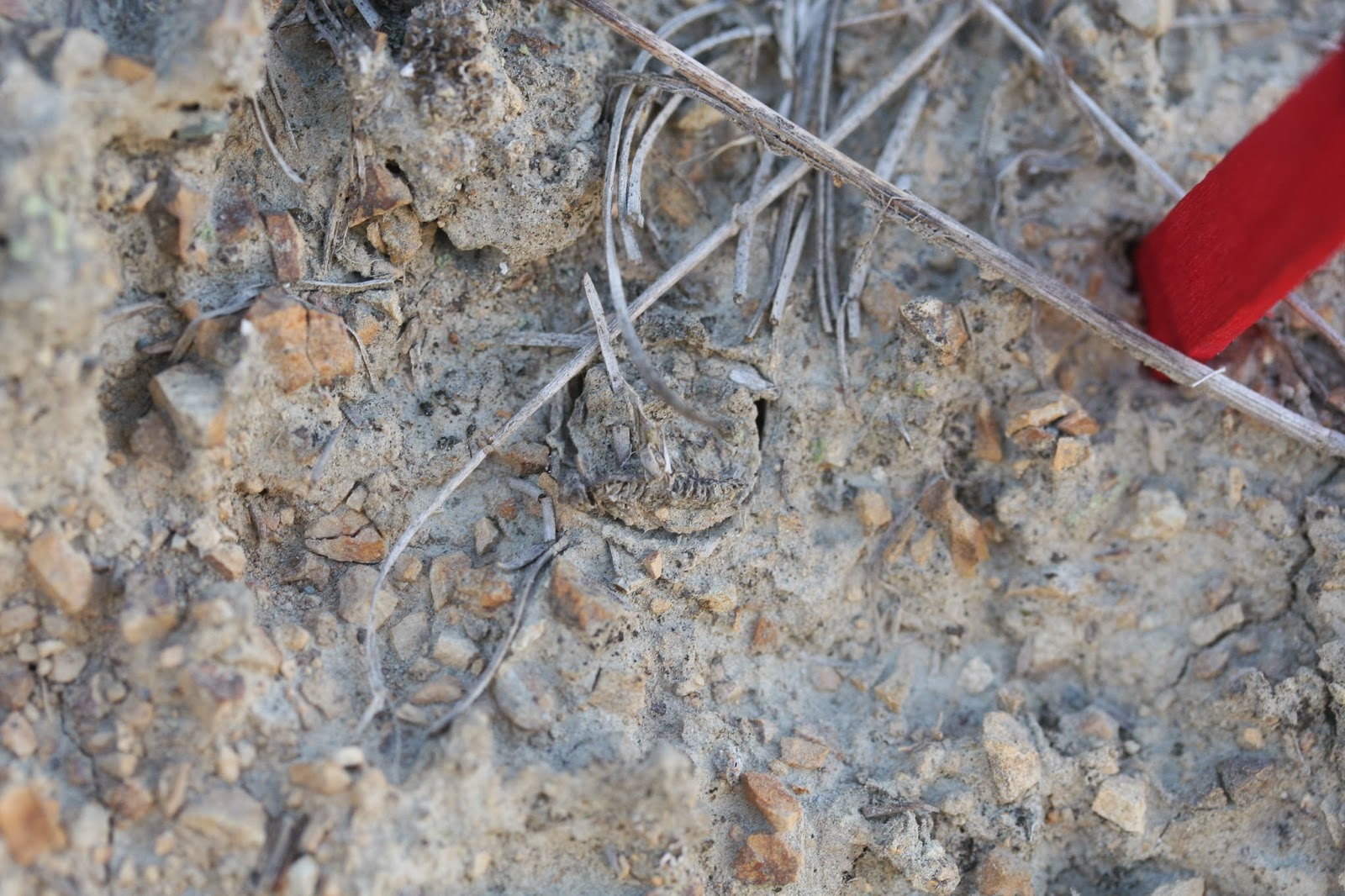
It was the best Christmas present I could have got - confirmation that not only do Cantuaria exist away from places where there are advisors and spider enthusiasts, but that I could find them. I found around 20 more burrows, but I could have found more if I'd kept looking. Some of the holes were pretty big, others rather small.

I harnessed up the beetle, ready to work when the sun went down.


At first, no spider came out - the beetle did not seem tempting enough. Then I used my advisor's trick of tickling the entrance with a blade of grass. That was successful in getting the spider to shoot out, then quickly jump back into its burrow. Using the grass to get the spider's attention, then the beetle to tempt it fully out of the burrow, seemed to be the best method. These spiders were quite unlike the Cantuaria dendyi that we had caught last time - they were larger, blacker, and quicker. When the C. dendyi were about to attack the beetles, the lid began to open a little and you could sometimes see the spider underneath - but with these spiders (which are probably C. depressa), the lid remained closed for ages and you started to think that the spider was not going to come out. Then, just as you are thinking of moving on to another burrow, the lid flies open and a spider explodes out. The first few made me jump.
I collected four, had a look at the car, poked one of the spark plugs back in and topped up the oil. Apparently that was all that was wrong with it that time. Then I drove back, happy that I did at least manage to collect from one population of Cantuaria.
A note about Christmas and other times of traditional socialisation and celebration
I expect that, for most international students, Christmas and other celebration times can get a bit lonely. You're away from your family, most people have left university to be on holiday (but you are expected to work), and you have no money. Important things to remember are that soon the holiday season will be over and you will be no worse off for having experienced it, as self-pity soon fades when you are surrounded by exciting and difficult things to do. It is also a good idea to find people who are both nice and in the same situation as you, and spend Christmas with them. That way you kind of make your own makeshift family. I don't normally get bothered by these things though, because Christmas in NZ doesn't feel like UK Christmas at all, and because I don't much like spending my days with heaps of drunk people anyway.
Merry belated Christmas to all, and happy New Year!
Subscribe to:
Posts (Atom)